
Activating the Indigenous Estate Requires Unity - and Economic Courage
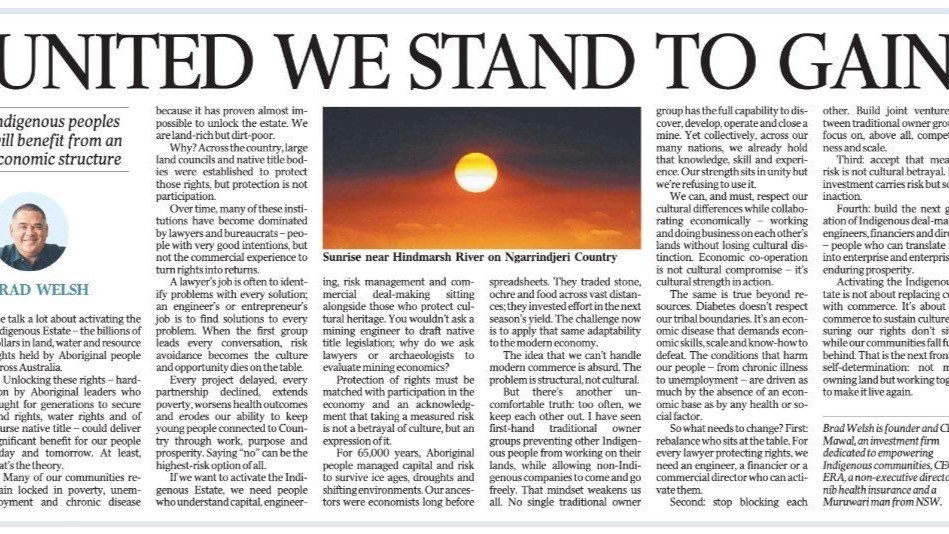
First published in The Australian and reposted on LinkedIn
---
Penned by Brad Welsh, founder and CEO of Mawal
We talk a lot about activating the Indigenous Estate, the billions of dollars in land, water and resource rights held by Aboriginal people across Australia.
Unlocking these rights - hard-won by Aboriginal leaders who fought for generations to secure land rights, water rights and of course native title could deliver significant benefit for our people today and tomorrow. At least, that’s the theory.
Many of our communities remain locked in poverty, unemployment and chronic disease. because it has proven almost impossible to unlock the estate. We are land rich but dirt poor.
Why? Across the country, large land councils and Native Title bodies were established to protect those rights but protection is not participation.
Over time, many of these institutions have become dominated by lawyers and bureaucrats - people with very good intentions, but not the commercial experience to turn rights into returns.
A lawyer’s job is often to identify problems with every solution; an engineer’s or entrepreneur’s job is to find solutions to every problem. When the first group leads every conversation, risk avoidance becomes the culture and opportunity dies on the table.
Every project delayed, every partnership declined, extends poverty, worsens health outcomes and erodes our ability to keep young people connected to Country through work, purpose and prosperity. Saying “no” can be the highest-risk option of all.
If we want to activate the Indigenous Estate, we need people who understand capital, engineering, risk management and commercial deal making sitting alongside those who protect cultural heritage.
You wouldn’t ask a mining engineer to draft native title legislation, why do we ask lawyers or archaeologists to evaluate mining economics?
Protection of rights must be matched with participation in the economy and an acknowledgement that taking a measured risk is not a betrayal of culture, but an expression of it.
For 65,000 years, Aboriginal people managed capital and risk to survive ice ages, droughts and shifting environments. Our ancestors were economists long before there were spreadsheets.
They traded stone, ochre and food across vast distances; they invested effort in the next season’s yield. The challenge now is to apply that same adaptability to the modern economy.
The idea that we can’t handle modern commerce is absurd. The problem is structural, not cultural.
But there’s another uncomfortable truth: too often, we keep each other out. I have seen firsthand Traditional Owner groups preventing other Indigenous people from working on their lands, while allowing non-Indigenous companies to come and go freely. That mindset weakens us all.
No single Traditional Owner group in this country has the full capability to discover, develop, operate and close a mine. Yet collectively, across our many nations, we already hold that knowledge, skill and experience. Our strength sits in unity but we’re refusing to use it.
We can, and must, respect our cultural differences while collaborating economically - working and doing business on each other’s lands without losing cultural distinction. Economic cooperation is not cultural compromise - it’s cultural strength in action.
The same is true beyond resources. Diabetes doesn’t respect our tribal boundaries. It’s an economic disease that demands economic skills, scale and know-how to defeat.
The conditions that harm our people - from chronic illness to unemployment - are driven as much by the absence of an economic base as by any health or social factor.
So what needs to change? First: rebalance who sits at the table. For every lawyer protecting rights, we need an engineer, a financier, or a commercial director who can activate them.
Second: stop blocking each other. Build joint ventures between Traditional Owner groups to focus on above all competitiveness and scale.
Third: accept that measured risk is not cultural betrayal. Every investment carries risk but so does inaction.
Fourth: build the next generation of Indigenous dealmakers - engineers, financiers and directors - people who can translate rights into enterprise and enterprise into enduring prosperity.
Activating the Indigenous Estate is not about replacing culture with commerce. It’s about using commerce to sustain culture - ensuring our rights don’t sit idle while our communities fall further behind.
That is the next frontier of self-determination: not merely owning land but working together to make it live again.
Brad Welsh is the Founder and CEO of Mawal, Chief Executive Officer and Managing Director of ERA, a Non-Executive Director of nib Health Insurance, the AFR’s Emerging Director of the Year 2025 and a Muruwari man from New South Wales.