
Curiosity is a career accelerant: From Redfern to the ASX
First published on Australian Financial Review
---
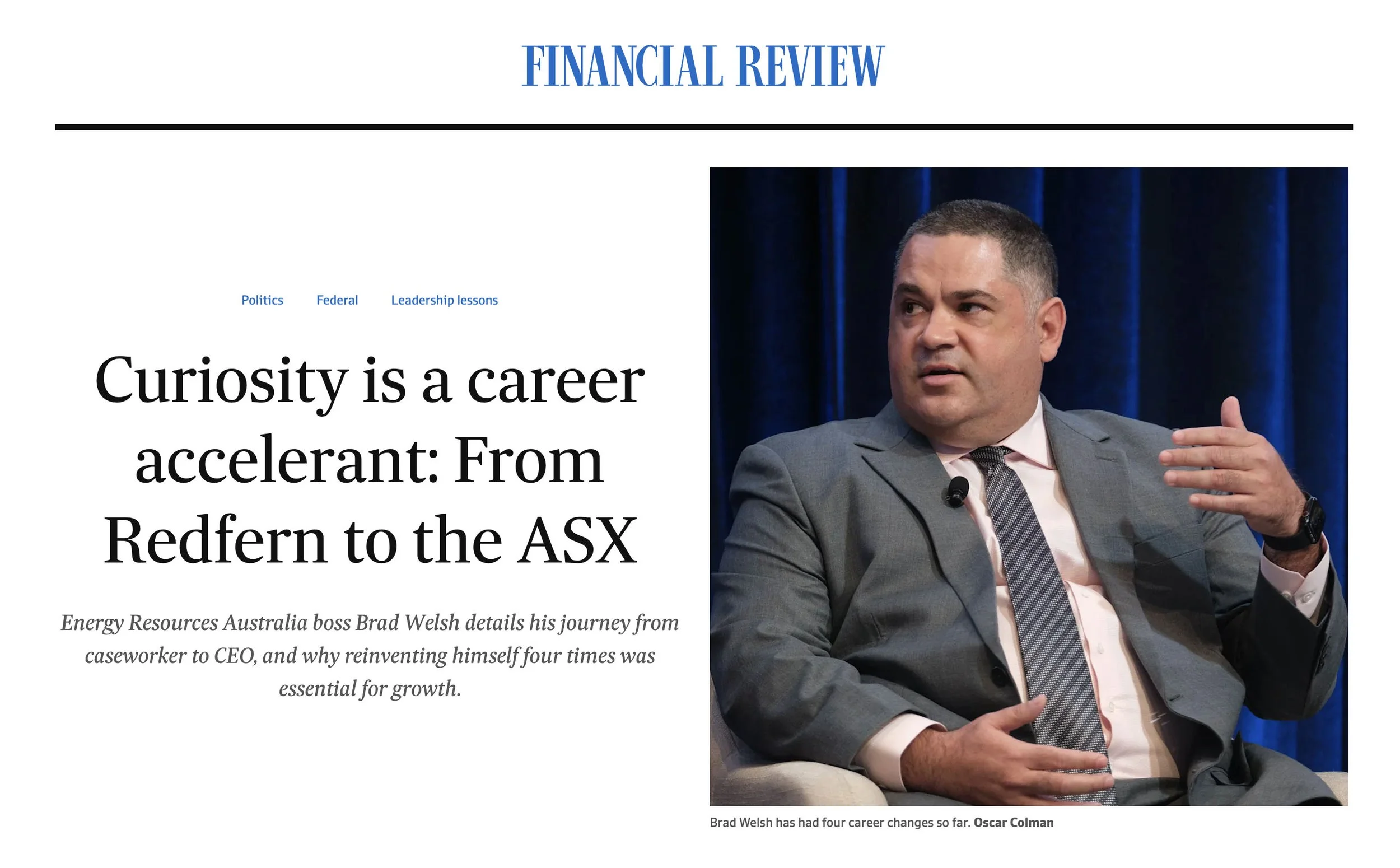
This is an extract of Brad Welsh’s (founder and CEO of Mawal) speech to the alumni of CareerTrackers on February 6, 2026.
Legacy isn’t something you talk about when you retire. Legacy is something you are quietly building or eroding every year of your career.
Before I go any further, I want to acknowledge something extraordinary about this room. You have all joined roughly 5 per cent of the entire Indigenous population who have university degrees.
That’s around 50,000 people. That is not an accident. That is not luck. That is the result of generations of struggle.
To understand what that really means, we have to remember what education was designed to be for Aboriginal people not that long ago.
Chicka Dixon, one of the great Redfern leaders, used to describe Indigenous schooling in NSW in the 1930s, 40s and 50s as largely run by the wife of the mission manager. In many cases, she was illiterate herself. Later in his life, Chicka said he believed that wasn’t incompetence, it was strategy – a system designed to keep Aboriginal people fit only for cheap labour.
And into the 1960s and 70s, it was normal for Aboriginal children to be pushed out of school at Year 8. It was believed we didn’t have the intellectual capacity to learn beyond that level. Parents had to fight for their kids to be allowed to stay in school. That was the ceiling.
Your generation does not live with those shackles any more. But that means something uncomfortable. We now have to look in the mirror and ask: are we really breaking the ceiling for our next generations?
Because degrees don’t create legacy on their own. What you do with them does. I didn’t get to where I am by following a straight line. I got here by deliberately reinventing myself four times, and each time it was uncomfortable (and at some points I was genuinely scared).
I started as a child protection caseworker in Redfern. It was frontline work. It mattered.
It was emotionally brutal. And it taught me two things very quickly. Systems shape lives far more than intentions. And if you stay too long in frontline roles, you get trapped responding to outcomes instead of shaping causes.
I was good at that job, and I was promoted quickly into management. But I could see the ceiling. So I made what many thought was a strange decision. I stepped down to become a media assistant in the prime minister’s office. From a management role to photocopying, transcribing press conferences, writing briefs, watching press cycles.
I had no background in media. I was starting at 4am and finishing at 7pm. I felt out of my depth more than once. But I was curious. I wanted to understand how power really worked.
That job taught me how decisions are framed, how reputations are built and destroyed, how governments communicate under pressure It was a pay cut. It was an ego hit. It was a long-term investment.
It also reinforced something I’ve come to believe deeply – curiosity is a career accelerant. If you are genuinely curious about how things work, not just for your function, but the whole system, then doors will start to open.
During the global financial crisis, I had a front-row seat into how the nation responded, what the government could do and importantly what the government couldn’t do.
I realised something important; that the bulk of the economy, jobs and our standard of living was delivered by the private sector. That if we wanted to deliver real change to Indigenous communities at scale, we had to understand and influence that engine.
From there I moved into state government, working for the planning minister. Most people think planning is boring. It isn’t. Planning is where projects live or die. Where capital either moves or stalls. Where mines, ports, housing and infrastructure either get approved or killed.
It was the first time I saw how balance sheets connect to policy. How capital needs regulatory permission to move. I learned how environmental approvals work, how stakeholders influence outcomes, how ministers get briefed, how power really flows.
I wasn’t in Indigenous Affairs. I wasn’t community liaison. I was inside the machinery of economic decision-making.
That was deliberate.
Then I moved into Rio Tinto. I started in Communities and Social Performance. That was my entry point into mining. I worked on an approval for the mine and learned more and more about Rio Tinto.
I was curious – I asked myself continuous questions what makes this mine work, how does it generate money, how does it compete against other mines and what impact do I have on any of those questions.
Communities and Social Performance is important work, but it has a ceiling. I could see very clearly that if I stayed too long in that function, I would become an Indigenous leader rather than a leader who happens to be Indigenous. That distinction matters.
So I did something many people thought was stupid. I actively declined Indigenous-specific roles. I declined General Manager roles inside CSP, even really attractive overseas placements. I pushed sideways into operations.
Why? Because balance sheets live in operations. Production, cost, safety, logistics, asset performance. That is where you earn your seat.
I moved to Weipa and lived there for 10 years. I learned how mines run. How ships get loaded. How budgets get built. How breakdowns cost millions.
That was where my ceiling lifted and where I learned what real leadership actually means. In operations, half the workforce reported into my structure. Hundreds of families depended on decisions I made. Fear doesn’t disappear when you get promoted, it gets heavier.
It was there that I learned that you don’t move the balance sheet yourself, you move it through people. When production misses target, I’m not driving the truck. When a ship doesn’t load, I’m not fixing the conveyor.
Leadership is multiplication. Your value stops being what you can do. It becomes what you can unlock in others.
If you want to influence capital allocation you must be able to lift performance and build teams that outperform – with or without you in the room. Setting standards, giving hard feedback, driving results.
I often think of what opportunities would I have really got if I had never been courageous and made the sacrifice to move to a remote location.
So onto 2020, and that’s when Rio Tinto had the events of Juukan Gorge. At the time I was the most senior Indigenous employee in the company even though I wasn’t based in Iron Ore or WA. I was asked to step into a global recovery role, reporting to the CEO of Rio Tinto.
When he asked me, I said something very clearly. I want to be a senior leader who is Indigenous, not a senior Indigenous leader. I want to manage the balance sheet, not just NAIDOC week.
That’s not to say NAIDOC week doesn’t matter. But symbolic leadership without economic authority has limits.
He respected that, and he was honest. He said this issue is the company’s biggest issue right now, that will give you exposure to everything, and you will have the chance to direct the company’s future. He was also clear that it will not always be the company’s biggest problem. We need to move you back into a role that survives when it isn’t.
So we engineered an exit into a listed-company CEO role after about 12 months to continue my career as a senior leader who happens to be Indigenous. That is how I became CEO and managing director of Energy Resources of Australia, the first Indigenous CEO and managing director of an ASX-listed company.
Leading an ASX company comes with public scrutiny, financial pressure and decisions that move markets. I can you tell it’s a different weight when your name is attached to quarterly results.
From there a number of opportunities opened up, over almost 12 months I was appointed to the board of nib Holdings. This was a completely different industry and sector, it gave me a completely different network and exposure, and it had some common features with the mining industry.
This is where I realised that the one consistent feature in particular of the private sector is a focus on “growth”, it has to be sustainable growth of course, but the primary focus is growth.
I want to also be clear here that “growth” isn’t a dirty word. Growth is the right objective and goal for anyone not just the private sector. Our people have been trying to grow the Indigenous estate since 1788, we have been trying to grow opportunities for the next generation and even more retail we have been trying to grow our annual pay each year to deliver different lives to our families and community.
Why is corporate or private sector growth so shunned then by our people or at least not talked about in preference for reconciliation action plans and social objectives.
Remember it is the economic horse that pulls the social cart not the other way around. That is not symbolic. That is balance-sheet accountability.
OK so here is the uncomfortable truth.
Legacy is not only measured in how many people you help. Helping people matters, and it always will, BUT structural economic power changes scale.
Growing your career, growing the balance sheet and growing the economic base for our people to realise our rightful place in the nation’s social and economic fabric. That’s legacy.
If you cannot point to a P&L, if you cannot influence capital allocation, if you cannot say this decision changes the numbers, then you are still in the support system, not in the control system.
That is the new ceiling.
Our grandparents were locked out of education. Our parents had to fight to finish school. You have degrees.
But are you using them to move into the rooms where economic decisions are made, or are you just circulating inside programs that feel safe?
Indigenous-facing roles are essential, but they do not run the company. Too many of our brightest people are gently steered into those roles because they are natural fits. Natural fits can become the new ceiling.
I want every person in this room to ask yourself one hard question. Am I moving closer to, or further away from, the balance sheet?
Does my role teach me how revenue is generated, how costs are controlled, how capital is allocated, how risk is priced?
If not, you are not yet writing the next chapter of Indigenous advancement. You are still inside someone else’s.
Ambition is rarely an individual act; it’s a collective one. None of us climb alone. The Redfern generation changed Australia by forcing itself into the centre of the national stage.
Your generation has something even more powerful. You are already inside the institutions that run the country.
Your legacy will not be built by how Aboriginal you are. It will be built by how economically consequential you become.
When you combine cultural strength with balance-sheet authority, when you can read the balance sheet and lead the people who move it – you stop being the exception.
Imagine a future where the first Indigenous CEO of large ASX company is not lonely. Where it is normal. And we’re not celebrating “the first” but debating performance like everyone else.
That future will not be built by symbolism. It will be built by competence, courage, curiosity and leadership.
You don’t just honour the past and all those parents who fought to keep their child in school past Year 8, you raise the ceiling for those who follow.
You change history.
Brad Welsh is the Founder and CEO of Mawal, Chief Executive Officer and Managing Director of ERA, a Non-Executive Director of nib Health Insurance, the AFR’s Emerging Director of the Year 2025 and a Muruwari man from New South Wales.